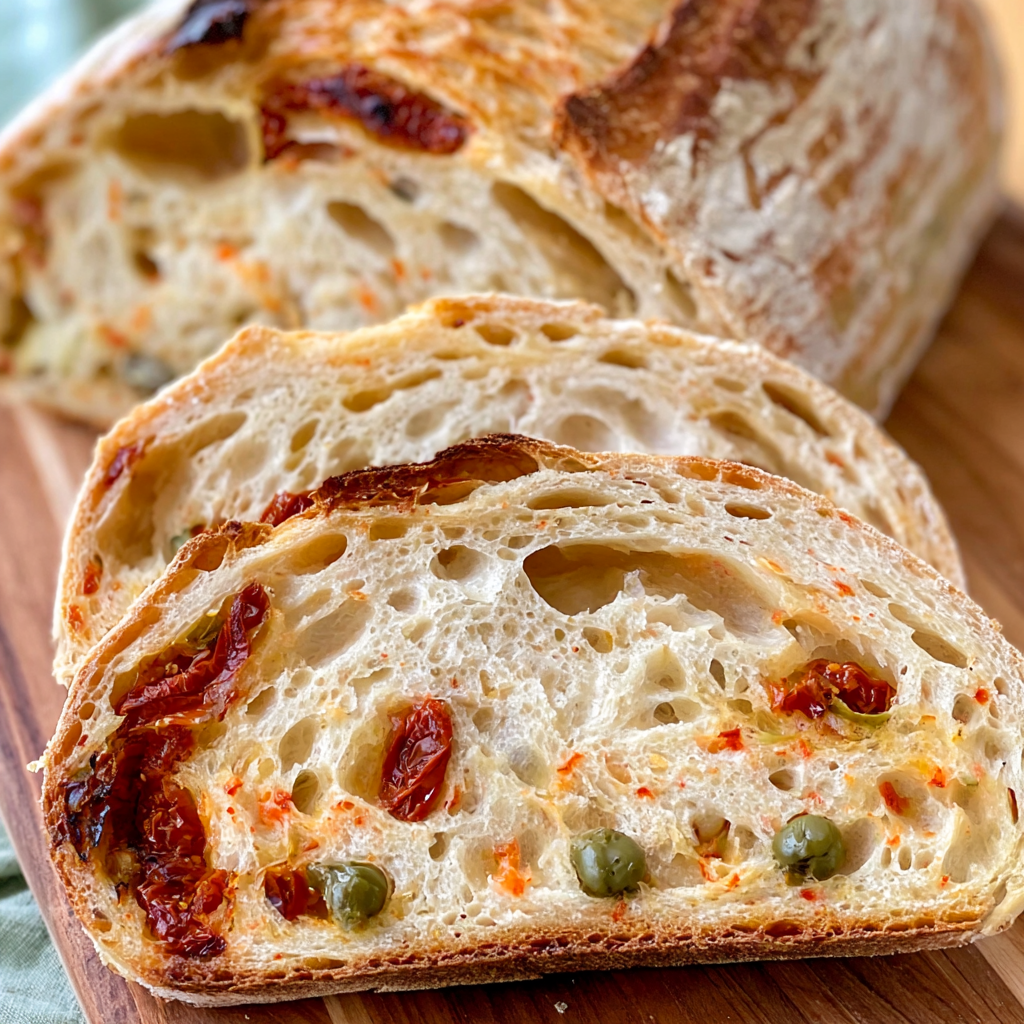
Sun-Dried Tomato Sourdough Bread
This naturally leavened artisan loaf combines a tender, airy crumb with savory sun-dried tomatoes, briny capers, oregano, and crushed red pepper. An extended cold proof deepens the flavor while making the dough easier to score and bake.
Pin it to remember it!
Print Recipe
Ingredients
Levain
- 30 g bread flour
- 30 g water
- 30 g active sourdough starter
Dough
- 60 g whole-wheat flour
- 307 g water plus as much as 10 g additional water if required
- 8 g fine sea salt
- 340 g bread flour
- Entire prepared levain or 90 g vigorous sourdough starter
Mix-Ins
- 1 teaspoon crushed red pepper flakes
- 56 g dry-packed sun-dried tomatoes chopped
- 1½ teaspoons dried oregano or 1 tablespoon fresh oregano leaves
- 70 g capers rinsed thoroughly, dried, and chopped
Instructions
- Loosely cover the jar and keep it in a warm area maintained between 75°F and 80°F. Allow the levain to ferment for approximately 5 hours, or until it is bubbly and has doubled in volume.
- Alternatively, omit the levain preparation and add 90 g of lively sourdough starter directly to the dough in Step 3.
- Once the levain is mature, place the bread flour and whole-wheat flour in a large mixing bowl. Form a hollow in the center and pour in 307 g of water.
- Combine the ingredients with your hands or a dough whisk just until all the flour is moistened and a rough, shaggy dough develops.
- Cover the bowl and leave the dough in a warm place for 30 minutes. This resting period encourages extensibility and supports flavor development.
- Add the entire prepared levain, or 90 g of active sourdough starter, to the rested dough.
- Moisten your hands and press the levain gently into the dough with your fingertips. Continue incorporating it with stretching and folding motions until it is roughly distributed.
- Cover the bowl and allow the dough to rest for 30 minutes.
- Scatter the sea salt evenly over the dough. Press the salt into the surface, then stretch and fold the dough for approximately 5 minutes, continuing until the salt has dissolved and the mixture feels cohesive.
- When the dough appears overly firm, gradually work in up to 10 g of additional water. Add only a small amount at a time, stopping once the dough feels soft without becoming excessively sticky.
- Cover the bowl and rest the dough in a warm location for another 30 minutes.
- Maintain the dough at approximately 78°F or 26°C during bulk fermentation. The complete bulk-rise stage should take about 5 hours.
- After the first 30 minutes, complete one set of stretch-and-folds. Lift one side of the dough gently and fold it over the center, repeating from each side.
- Let the dough rest for another 30 minutes.
- Lightly moisten the work surface and your hands. Carefully extend the dough into a broad, thin sheet without tearing it.
- Distribute the chopped sun-dried tomatoes, prepared capers, oregano, and crushed red pepper flakes evenly over the stretched dough.
- Fold the dough over itself to create a compact packet, enclosing the additions through lamination.
- Allow the dough to rest for 45 minutes.
- Complete another two or three sets of stretch-and-folds, leaving approximately 45 minutes between each set.
- After the final fold, leave the dough undisturbed for the remainder of bulk fermentation. It is ready when it has nearly doubled, looks aerated, feels light, and moves with a gentle jiggle when the bowl is shaken.
- Lightly dust both the dough and the work surface with flour.
- Ease the fermented dough away from the bowl and carefully turn it onto the counter.
- Using a bench scraper, form the dough into either an oval bâtard or a round boule.
- Gently tuck any exposed pieces of tomato or caper beneath the dough’s surface to reduce the chance of scorching during baking.
- Transfer the shaped loaf to a thoroughly floured banneton. When the dough feels loose, strengthen the underside by pinching or stitching the edges together.
- Cover and leave it at room temperature for 15 to 30 minutes. For a slightly firmer surface and improved crust formation, leave the banneton uncovered during the final 10 minutes.
- Cover the banneton and refrigerate the shaped loaf overnight. It may remain under cold proof for as long as 2 days.
- This slow fermentation develops a more complex flavor and firms the dough, making it easier to score and transfer for baking.
- Place a Dutch oven and its lid inside the oven. Preheat both at 500°F or 260°C for 1 hour.
- Remove the banneton from the refrigerator and immediately turn the cold dough onto a sheet of parchment paper.
- Using a bread lame, score the surface approximately ¼ to ½ inch deep.
- Lift the loaf with the parchment paper and lower it carefully into the heated Dutch oven. Cover with the lid and bake at 500°F or 260°C for 20 minutes.
- Remove the lid, lower the oven temperature to 450°F or 232°C, and continue baking for approximately 15 minutes, or until the crust becomes deeply golden brown.
- Transfer the loaf from the Dutch oven to a wire rack. Cool for no less than 1 hour before cutting.
Notes
Dry-packed sun-dried tomatoes are recommended rather than tomatoes preserved in oil.
Rinse and dry the capers carefully before chopping them to prevent excess moisture from entering the dough.
Fresh oregano may replace the dried oregano; use 1 tablespoon of fresh leaves in place of 1½ teaspoons dried.
The finished bread may be served with high-quality olive oil or an assortment of cheeses.