
Sun-Dried Tomato Sourdough Bread delivers a chewy, airy crumb packed with tangy tomatoes, briny capers, oregano, and gentle heat, with an overnight cold proof that builds deeper flavor and makes baking more manageable.
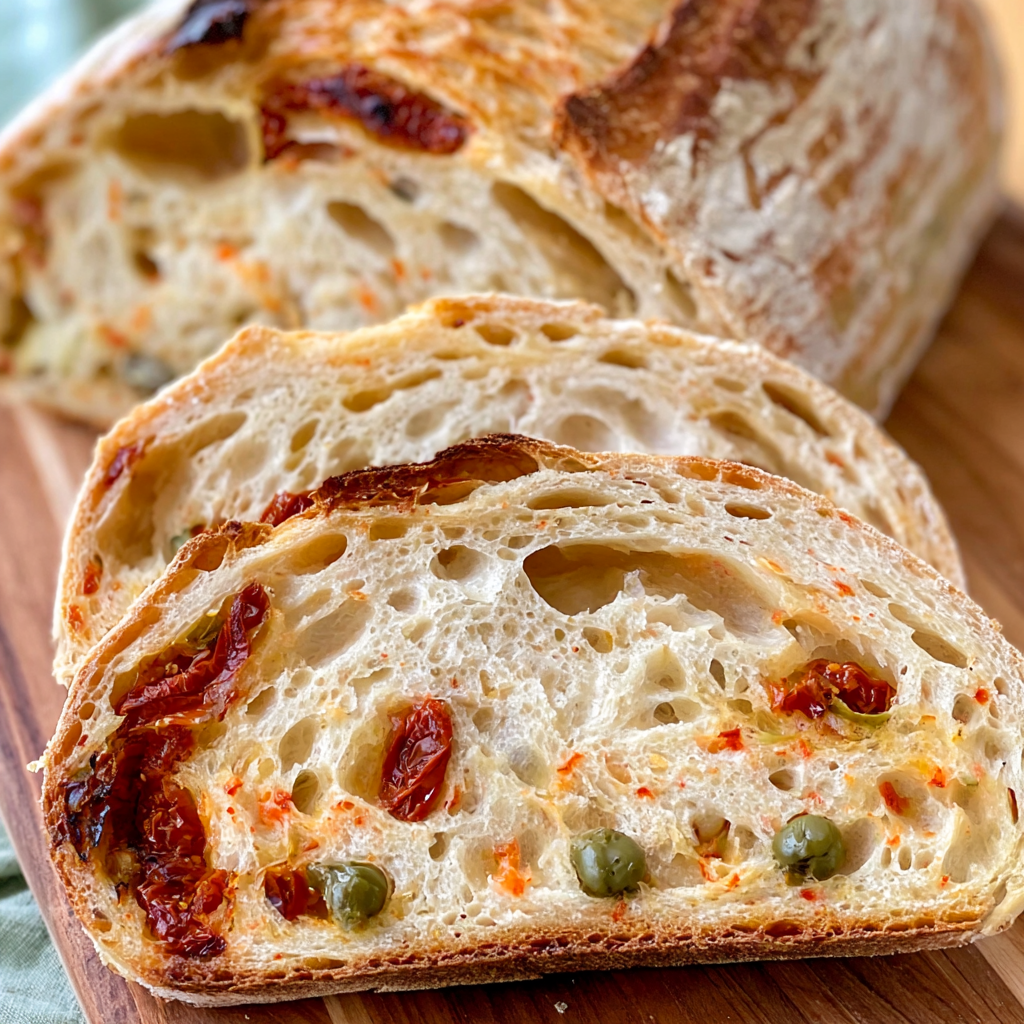
This is the kind of loaf to make when you want homemade sourdough that feels special without turning it into a complicated showpiece. The mix-ins bring bold Mediterranean-inspired flavor to every slice, so the bread is satisfying even with nothing more than a little olive oil.
The method works because the tomatoes, capers, herbs, and pepper flakes are added through lamination after the dough has begun developing strength. That helps distribute the savory additions without crushing the air you have already built into the dough.
Plan to start the levain earlier in the day, shape the loaf after bulk fermentation, and refrigerate it overnight. The next day, the dough will be firm, flavorful, and ready to score straight from the refrigerator.
Ingredients
- Active sourdough starter, 30 grams: Provides the natural leavening needed to raise the bread and develop its characteristic tangy flavor.
- Bread flour, 370 grams total: Builds a strong gluten network that can support the high hydration, savory additions, and airy crumb.
- Whole-wheat flour, 60 grams: Adds subtle nuttiness, encourages active fermentation, and gives the loaf more depth than bread flour alone.
- Water, 337 grams total, plus up to 10 grams if needed: Hydrates the flour and creates a soft, extensible dough. Hold back the extra water unless the dough feels unusually firm.
- Fine sea salt, 8 grams: Strengthens the dough while balancing the acidity of the starter and the salty bite of the capers.
- Dry-packed sun-dried tomatoes, 56 grams: Bring concentrated tomato flavor and a pleasantly chewy texture without adding excess oil.
- Capers, 70 grams: Add a sharp, briny contrast. Rinsing and drying them keeps the loaf from becoming overly salty or wet.
- Oregano, 1½ teaspoons dried or 1 tablespoon fresh: Gives the loaf an aromatic Mediterranean character that pairs naturally with the tomatoes.
- Crushed red pepper flakes, 1 teaspoon: Add gentle background heat without overpowering the fermented flavor of the bread.

Cooking Steps
STEP 1: Build the levain by stirring 30 grams each of active starter, bread flour, and water in a clean jar. Cover it loosely and keep it around 75°F to 80°F for roughly 5 hours. It is ready when it has doubled, looks aerated, and smells pleasantly fermented. You may also skip this stage and use 90 grams of vigorous starter.
STEP 2: Combine the remaining bread flour and the whole-wheat flour in a large bowl. Add 307 grams of water and mix until no dry flour remains. The dough will look rough and shaggy rather than smooth. Cover it and let it rest for 30 minutes so the flour can hydrate and the gluten can begin developing naturally.
STEP 3: Add the mature levain to the rested dough. Use damp fingertips to press it in, then fold and squeeze the dough until the starter is distributed. Rest for 30 minutes, sprinkle in the salt, and work the dough for about 5 minutes. Add up to 10 grams of extra water only when the dough feels too firm.
STEP 4: Begin bulk fermentation at approximately 78°F. After 30 minutes, complete a full set of stretch-and-folds by lifting each side of the dough and folding it toward the center. Rest for another 30 minutes. This first fold gives the dough enough strength to hold the mix-ins without tearing.
STEP 5: Lightly dampen the counter and carefully stretch the dough into a wide, thin sheet. Scatter the chopped tomatoes, rinsed and dried capers, oregano, and red pepper flakes across the surface. Fold the dough into a compact packet, enclosing the additions in layers. Return it to the bowl and let it rest for 45 minutes.
STEP 6: Perform two or three additional stretch-and-fold sets, allowing about 45 minutes between each one. Leave the dough undisturbed after the final fold until the total bulk fermentation reaches about 5 hours. Look for a nearly doubled volume, bubbles along the sides, a light feel, and a gentle wobble when the bowl is moved.
STEP 7: Turn the dough onto a lightly floured counter and shape it into a boule or bâtard. Tuck exposed pieces of tomato and caper underneath so they are less likely to burn. Place the loaf seam-side up in a well-floured banneton, cover it, and refrigerate overnight or for up to 2 days. When ready to bake, preheat a Dutch oven at 500°F for 1 hour. Score the cold loaf, bake it covered for 20 minutes, then uncover, lower the heat to 450°F, and bake for about 15 minutes more. Cool on a rack for at least 1 hour before slicing.
Perfect Pairings
- Serve thick slices with a shallow dish of extra-virgin olive oil for dipping. The oil softens the crust slightly and highlights the oregano and tomato flavors.
- Add the bread to a simple cheese board with mild, creamy, or aged cheeses. Its briny, spicy character provides enough flavor to make a small spread feel complete.
- Pair it with tomato soup, lentil soup, or a crisp green salad for a light lunch. Toasted slices are especially good when you want extra crunch beside a soft or brothy dish.
Can I use oil-packed sun-dried tomatoes?
Dry-packed tomatoes are the most reliable choice because they do not introduce extra oil into the dough. Oil-packed tomatoes can work when thoroughly drained, chopped, and blotted dry, but the crumb may feel slightly softer and the dough can become more difficult to handle.
How can I tell when bulk fermentation is finished?
Watch the dough rather than relying only on the clock. It should look noticeably expanded, feel lighter, show bubbles around the edges, and jiggle gently when the bowl is shaken. In a cooler kitchen, bulk fermentation may take longer than 5 hours.
Can the shaped loaf stay refrigerated for two days?
Yes. A cold proof of up to 2 days can deepen the sour flavor and make the loaf easier to score. Keep the banneton well covered so the surface does not dry out, and bake the dough directly from the refrigerator while it is still firm.
Why should exposed tomatoes be tucked into the dough?
Tomato pieces and capers left on the outside can darken quickly against the hot Dutch oven. Tucking them beneath the surface protects the inclusions, creates a cleaner crust, and reduces the chance of bitter or scorched spots.

Helpful Tips
- Dry the capers thoroughly after rinsing. Extra surface moisture can make the laminated dough slippery and weaken the layers around the mix-ins.
- Use wet hands during folding instead of adding more flour. This keeps the dough hydrated while making it easier to stretch and handle.
- Let the loaf cool completely before cutting. Slicing too early can compress the crumb and make the interior seem gummy even when the bread is fully baked.
Keeping Leftovers Fresh
Allow the loaf to cool completely before storing it. Keep it cut-side down on a board for the first day, or place it in a paper bag or bread bag at room temperature for up to 2 days. This helps preserve the crust while protecting the crumb from drying too quickly.
For longer storage, refrigerate the bread in an airtight container for 4 to 5 days. Refrigeration can firm the crumb, so it is better for bread you plan to toast or reheat rather than serve fresh.
Freeze the loaf whole, in halves, or as individual slices for up to 3 months. Wrap it tightly and place it in a freezer-safe bag. Frozen slices can go directly into the toaster. To refresh a larger piece, thaw it, lightly mist the crust with water, and warm it in a 350°F oven for 8 to 12 minutes.
For the best texture, reheat only the amount you plan to eat. A toaster brings back crisp edges on individual slices, while a short oven reheating restores the crackly crust and soft center of a larger portion.
Sun-Dried Tomato Sourdough Bread
Ingredients
Levain
- 30 g bread flour
- 30 g water
- 30 g active sourdough starter
Dough
- 60 g whole-wheat flour
- 307 g water plus as much as 10 g additional water if required
- 8 g fine sea salt
- 340 g bread flour
- Entire prepared levain or 90 g vigorous sourdough starter
Mix-Ins
- 1 teaspoon crushed red pepper flakes
- 56 g dry-packed sun-dried tomatoes chopped
- 1½ teaspoons dried oregano or 1 tablespoon fresh oregano leaves
- 70 g capers rinsed thoroughly, dried, and chopped
Instructions
- Loosely cover the jar and keep it in a warm area maintained between 75°F and 80°F. Allow the levain to ferment for approximately 5 hours, or until it is bubbly and has doubled in volume.
- Alternatively, omit the levain preparation and add 90 g of lively sourdough starter directly to the dough in Step 3.
- Once the levain is mature, place the bread flour and whole-wheat flour in a large mixing bowl. Form a hollow in the center and pour in 307 g of water.
- Combine the ingredients with your hands or a dough whisk just until all the flour is moistened and a rough, shaggy dough develops.
- Cover the bowl and leave the dough in a warm place for 30 minutes. This resting period encourages extensibility and supports flavor development.
- Add the entire prepared levain, or 90 g of active sourdough starter, to the rested dough.
- Moisten your hands and press the levain gently into the dough with your fingertips. Continue incorporating it with stretching and folding motions until it is roughly distributed.
- Cover the bowl and allow the dough to rest for 30 minutes.
- Scatter the sea salt evenly over the dough. Press the salt into the surface, then stretch and fold the dough for approximately 5 minutes, continuing until the salt has dissolved and the mixture feels cohesive.
- When the dough appears overly firm, gradually work in up to 10 g of additional water. Add only a small amount at a time, stopping once the dough feels soft without becoming excessively sticky.
- Cover the bowl and rest the dough in a warm location for another 30 minutes.
- Maintain the dough at approximately 78°F or 26°C during bulk fermentation. The complete bulk-rise stage should take about 5 hours.
- After the first 30 minutes, complete one set of stretch-and-folds. Lift one side of the dough gently and fold it over the center, repeating from each side.
- Let the dough rest for another 30 minutes.
- Lightly moisten the work surface and your hands. Carefully extend the dough into a broad, thin sheet without tearing it.
- Distribute the chopped sun-dried tomatoes, prepared capers, oregano, and crushed red pepper flakes evenly over the stretched dough.
- Fold the dough over itself to create a compact packet, enclosing the additions through lamination.
- Allow the dough to rest for 45 minutes.
- Complete another two or three sets of stretch-and-folds, leaving approximately 45 minutes between each set.
- After the final fold, leave the dough undisturbed for the remainder of bulk fermentation. It is ready when it has nearly doubled, looks aerated, feels light, and moves with a gentle jiggle when the bowl is shaken.
- Lightly dust both the dough and the work surface with flour.
- Ease the fermented dough away from the bowl and carefully turn it onto the counter.
- Using a bench scraper, form the dough into either an oval bâtard or a round boule.
- Gently tuck any exposed pieces of tomato or caper beneath the dough’s surface to reduce the chance of scorching during baking.
- Transfer the shaped loaf to a thoroughly floured banneton. When the dough feels loose, strengthen the underside by pinching or stitching the edges together.
- Cover and leave it at room temperature for 15 to 30 minutes. For a slightly firmer surface and improved crust formation, leave the banneton uncovered during the final 10 minutes.
- Cover the banneton and refrigerate the shaped loaf overnight. It may remain under cold proof for as long as 2 days.
- This slow fermentation develops a more complex flavor and firms the dough, making it easier to score and transfer for baking.
- Place a Dutch oven and its lid inside the oven. Preheat both at 500°F or 260°C for 1 hour.
- Remove the banneton from the refrigerator and immediately turn the cold dough onto a sheet of parchment paper.
- Using a bread lame, score the surface approximately ¼ to ½ inch deep.
- Lift the loaf with the parchment paper and lower it carefully into the heated Dutch oven. Cover with the lid and bake at 500°F or 260°C for 20 minutes.
- Remove the lid, lower the oven temperature to 450°F or 232°C, and continue baking for approximately 15 minutes, or until the crust becomes deeply golden brown.
- Transfer the loaf from the Dutch oven to a wire rack. Cool for no less than 1 hour before cutting.