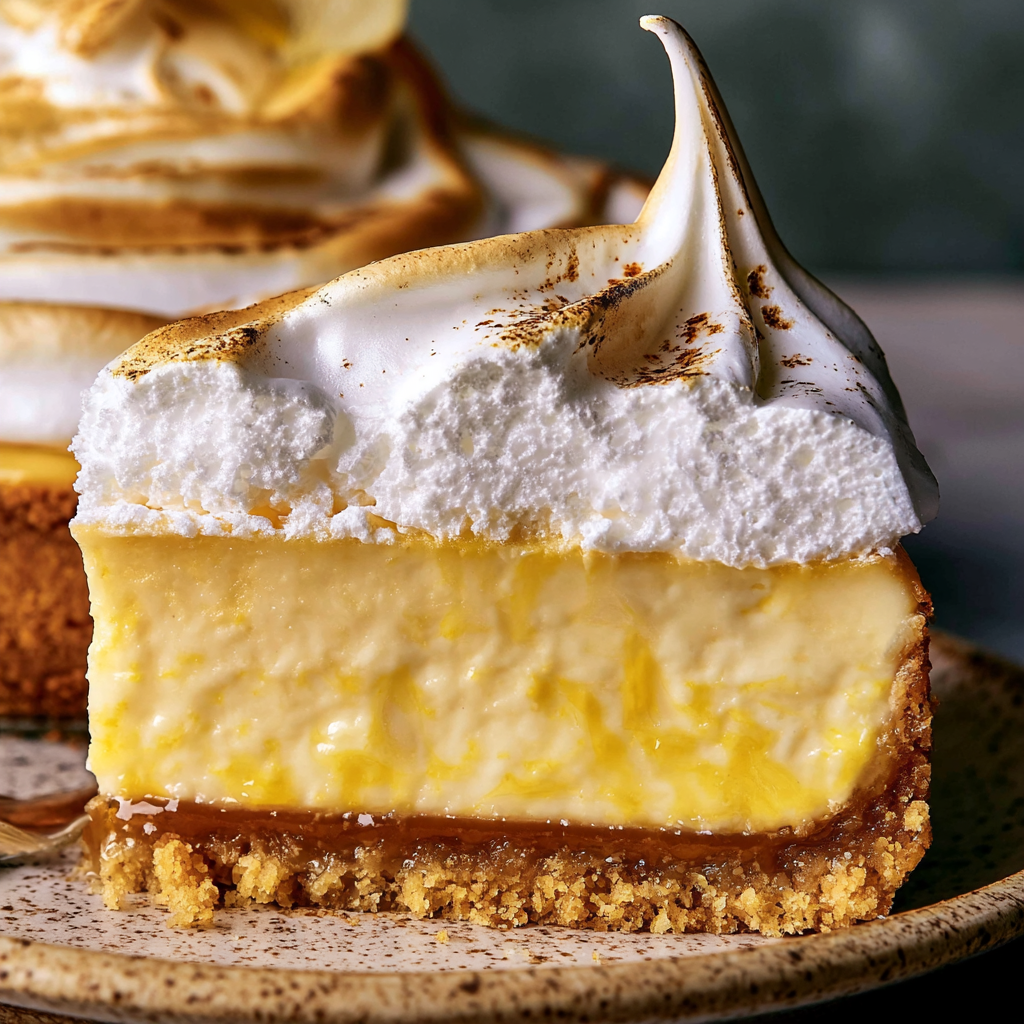
Lemon Meringue Pie Cheesecake
This layered dessert combines a buttery graham cracker base, a rich lemon-scented cheesecake, ribbons of homemade lemon curd, and a billowy vanilla meringue topping. A water-bath baking method and gradual cooling process produce a smooth, creamy texture, while the toasted meringue provides the classic finish of lemon meringue pie.
Pin it to remember it!
Print Recipe
Ingredients
For the lemon curd
- 6 tablespoons salted butter divided into small cubes
- 4 large eggs brought to room temperature
- Finely grated zest of 2 large lemons
- ¾ cup plus 1 tablespoon freshly squeezed lemon juice preferably from 4–5 lemons
- ½ teaspoon vanilla extract
- ¾ cup plus 2 tablespoons granulated sugar
- Small pinch of salt
For the graham cracker crust
- ½ cup plus 2 tablespoons salted butter melted and allowed to cool slightly
- 3 cups finely ground graham cracker crumbs
For the lemon cheesecake filling
- 32 ounces full-fat cream cheese softened to room temperature
- ⅓ cup plus 1 tablespoon lemon juice
- 2 teaspoons vanilla extract
- Finely grated zest of 2 large lemons
- 4 large eggs at room temperature
- ¾ cup full-fat sour cream at room temperature
- 1½ cups granulated sugar
For assembly
- 1 cup prepared and chilled lemon curd
For the meringue topping
- 4 large egg whites at room temperature, approximately 70°F
- ½ teaspoon cream of tartar
- 2 teaspoons vanilla bean paste or vanilla extract
- ⅛ teaspoon salt
- 1 cup granulated sugar
Instructions
- Place the finely grated lemon zest and granulated sugar in a non-metal saucepan. Rub the zest into the sugar with your fingertips until the mixture becomes fragrant and the citrus oils have been released.
- Beat the eggs in a separate small bowl, then set them aside. Position a fine-mesh strainer over a clean medium bowl.
- Add the lemon juice, beaten eggs, and salt to the zest-infused sugar. Whisk until the ingredients are thoroughly blended.
- Set the saucepan over low heat and cook for approximately 10–14 minutes, whisking continuously. Continue until the curd reaches 175°F and is thick enough to leave a coating on the back of a spoon.
- Remove the saucepan from the heat. Pour the curd through the prepared strainer to eliminate any cooked egg particles or lumps.
- Immediately add the vanilla extract and cubed salted butter. Whisk until the butter has melted completely and the curd is smooth.
- Press plastic wrap directly against the surface to prevent a skin from forming. Refrigerate for at least 3 hours before using. The curd may be prepared up to 4 days in advance.
- Preheat the oven to 350°F. Coat a 9-inch springform pan with nonstick cooking spray and confirm that the removable base is securely locked in place.
- Combine the graham cracker crumbs with the melted salted butter. Stir until the crumbs are evenly moistened and resemble damp sand.
- Transfer the mixture to the prepared pan. Compress it firmly across the base and extend it slightly up the sides.
- Bake for 10 minutes. Remove the crust from the oven and allow it to cool.
- After the pan has cooled, wrap the exterior base with foil in preparation for the water bath.
- Ensure that the cream cheese, eggs, and sour cream have reached room temperature before mixing.
- Combine the lemon zest and granulated sugar in a small bowl. Massage the zest into the sugar until the mixture becomes aromatic and slightly sandy in texture.
- Beat the softened cream cheese in a large mixing bowl for 1–2 minutes, or until creamy and uniform.
- Add the lemon-sugar mixture and continue beating for another 1–2 minutes. Stop periodically to scrape the bottom and sides of the bowl.
- Incorporate the eggs one at a time at medium speed. Scrape the bowl after each addition and avoid excessive mixing.
- Add the vanilla extract, sour cream, and lemon juice. Mix only until the filling is evenly combined.
- Transfer 2½ cups of the plain cheesecake batter to a medium bowl. Gently fold 1 cup of chilled lemon curd into this portion.
- Alternate spoonfuls of the plain batter and lemon-curd batter over the baked crust. Draw a butter knife through the two mixtures to create a marbled pattern without fully blending them.
- Bring a large pot of water to a boil.
- Place the filled springform pan inside a 10-inch cake pan. Position both pans inside a large roasting pan.
- Set the roasting pan on the oven rack. Carefully pour boiling water into the roasting pan so that it surrounds the outer cake pan without entering it.
- Bake at 350°F for 1 hour 40 minutes to 2 hours 12 minutes. The outer portion should appear set, while the center should retain a gentle wobble.
- Turn off the oven and leave the cheesecake inside. Prop the oven door slightly open and allow the cheesecake to cool gradually for 1 hour.
- Carefully remove the pans from the oven. Lift out the springform pan and discard any exterior foil.
- Set the cheesecake on a wire rack and allow it to cool completely at room temperature.
- Cover the cooled pan with foil and refrigerate overnight. The chilled cheesecake may be stored in the pan for up to 2 days before adding the topping.
- Before preparing the meringue, wipe the mixing bowl and utensils with vinegar to remove any traces of grease.
- Release the chilled cheesecake from the springform pan and transfer it to a serving plate. Spread a thin layer of lemon curd evenly across the surface.
- Combine the egg whites, granulated sugar, cream of tartar, and salt in a clean glass or metal bowl.
- Set the bowl over a saucepan containing approximately 1 inch of gently simmering water. Make certain that the base of the bowl does not touch the water.
- Whisk continuously for approximately 8 minutes, or until the mixture registers 175°F. The sugar should be fully dissolved and the egg whites gently heated.
- Remove the bowl from the saucepan and add the vanilla bean paste or vanilla extract.
- Beat the mixture on high speed for 4–5 minutes, until the meringue is glossy and forms stiff peaks.
- Immediately spoon the meringue over the cheesecake. Shape decorative peaks and swirls with the back of a spoon.
- Carefully toast the surface with a kitchen torch, following the torch manufacturer’s safety instructions.
- Slice and serve the cheesecake promptly after the meringue has been toasted. For the neatest portions, cut the dessert while it is thoroughly chilled.
- Transfer leftovers to an airtight container and refrigerate for 3–4 days.
Notes
A small drop of golden-yellow food coloring may be added to the lemon curd for a brighter appearance.
When the graham cracker mixture appears unusually dry or fails to hold together when pressed, incorporate an additional 1–2 tablespoons of melted butter.
A subtle amount of food coloring may also be blended into the lemon-curd cheesecake portion before swirling to create greater visual contrast.
Using a 10-inch cake pan as a barrier between the springform pan and the water bath provides additional protection against water seepage.
Extended refrigeration improves the cheesecake’s structure, flavor, and slicing quality.