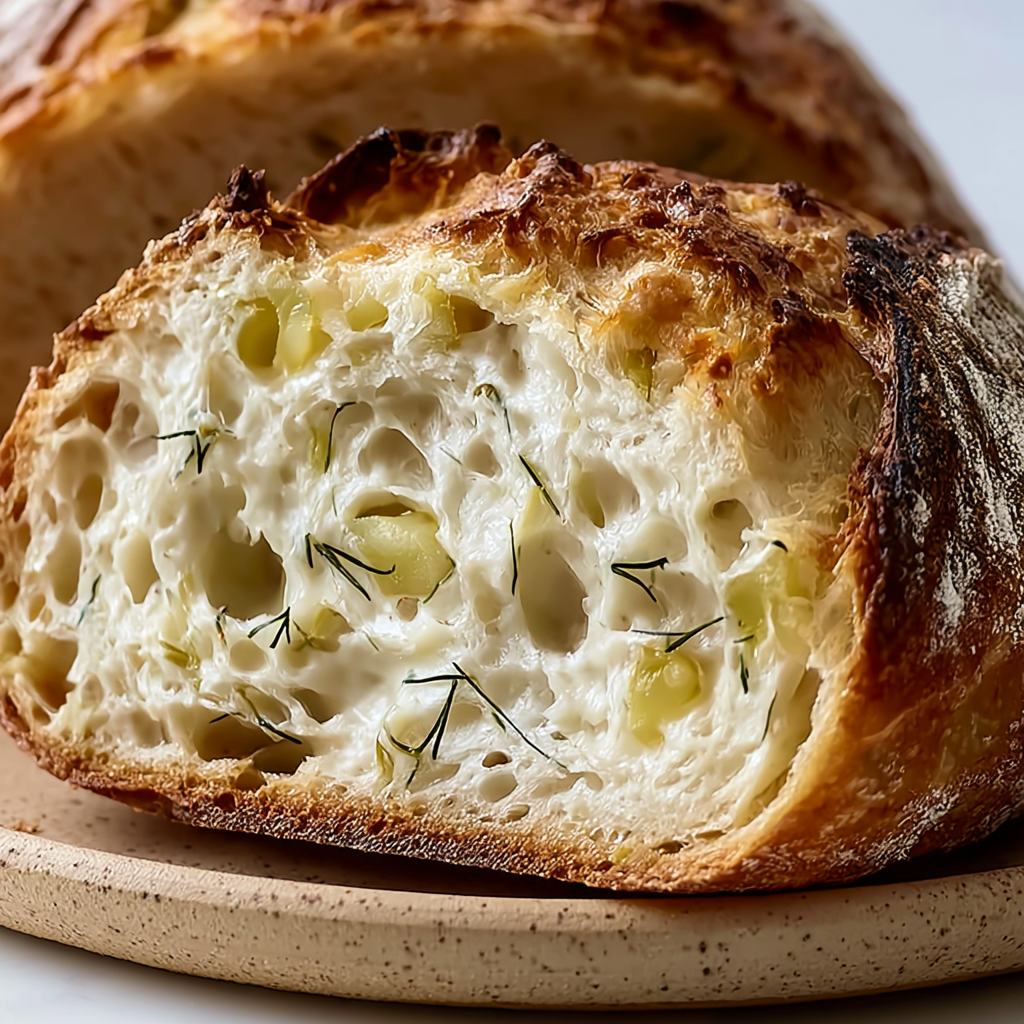
Tangy Dill Pickle Sourdough Bread
A naturally leavened sourdough loaf with a bright, savory character from dill pickle brine, chopped fresh dill, and small pieces of dill pickle folded into the dough. The finished bread has a crisp crust, a tender interior, and a pleasantly tangy flavor.
Pin it to remember it!
Print Recipe
Ingredients
For the dough:
- 35 g whole wheat flour
- 30 g dill pickle brine used to add tang and depth to the dough
- 375 g white bread flour
- 50 g lively active sourdough starter
- 260 g filtered water warmed to 85°F
- 7 g fine sea salt
For the mix-ins:
- 80 g dill pickles diced and blotted dry to reduce extra moisture
- 1 1/2 tablespoons fresh dill finely minced for even distribution
Instructions
- In a large mixing bowl, combine the active sourdough starter, warm filtered water, and dill pickle brine. Stir with a fork until the starter has loosened and dispersed through the liquid.
- Add the white bread flour and whole wheat flour. Begin mixing with a spatula, then continue by hand until a rough, shaggy dough forms and no dry flour remains visible.
- Scatter the fine sea salt over the surface of the dough. Cover the bowl with a damp cloth and allow the dough to rest for 40 minutes.
- After the resting period, knead the dough firmly by hand for 2 minutes to work the salt fully into the dough.
- Complete the first stretch-and-fold sequence by lifting one section of dough upward, stretching it gently, and folding it back over itself. Continue around the bowl until the dough has been folded from several sides.
- Cover the bowl again and let the dough rest for 30 minutes.
- After the rest, distribute the diced dill pickles and finely chopped fresh dill evenly across the dough, reaching toward the edges of the bowl.
- Perform another round of stretch and folds, working the pickles and dill into the dough as evenly as possible.
- Cover the dough and let it rest for another 30 minutes.
- Continue with 2 additional stretch-and-fold rounds, each followed by a 30-minute rest, for a total of 4 stretch-and-fold cycles. These folds help strengthen the dough and develop its structure.
- Once the folding sequence is complete, keep the dough covered with a damp cloth and leave it on the counter for bulk fermentation until it has risen by roughly 75%.
- At approximately 74°F, bulk fermentation will take about 4 hours. Cooler conditions may require more time, while warmer conditions may shorten the rise.
- The dough is ready for shaping when it is glossy, slightly under doubled in size, and showing a few bubbles near the surface.
- Gently transfer the dough onto a lightly floured work surface. Allow it to rest undisturbed for 10 to 15 minutes.
- Shape the dough as desired, then place it seam-side up in a flour-dusted, linen-lined banneton.
- Cover the banneton with a shower cap or damp cloth and allow the dough to complete its final proof.
- For the final rise, refrigerate the dough overnight for up to 12 hours, or let it proof at room temperature for about 1 1/2 hours.
- When the dough has risen slightly and looks visibly puffy, prepare to bake.
- Preheat the oven to 450°F with a Dutch oven inside.
- Place a sheet of parchment paper over the dough, then carefully invert it so the seam side faces down.
- Score the top of the loaf at least 1/2 inch deep to help steam escape and guide expansion during baking.
- Lift the dough with the parchment and place it into the hot Dutch oven. Cover with the lid.
- Bake at 450°F for 25 minutes.
- Remove the lid, reduce the oven temperature to 435°F, and continue baking for another 20 minutes, or until the crust is deeply golden and crisp.
- Transfer the loaf to a cooling rack and let it cool for at least 1 hour before slicing so the interior can set properly and avoid a gummy texture.