
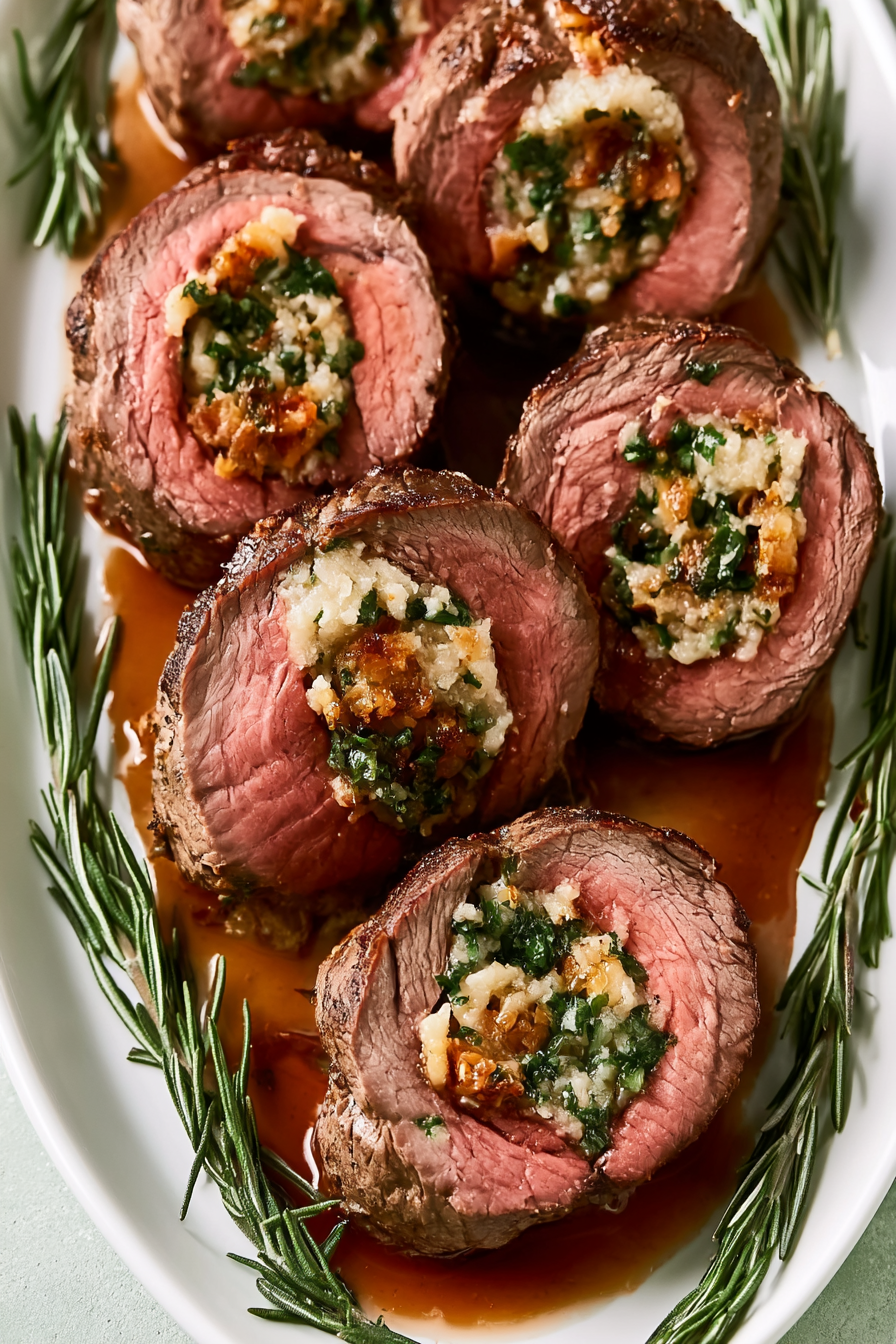
Christmas Stuffed Beef Tenderloin makes an impressive holiday centerpiece with tender roasted beef wrapped around a buttery breadcrumb, parsley, onion, and garlic filling. It slices beautifully, serves a crowd, and can be prepared ahead for easier entertaining.

When you want a main course that feels special enough for Christmas dinner, this stuffed tenderloin delivers without relying on a complicated list of ingredients. The savory parsley and garlic stuffing adds plenty of flavor while keeping the presentation classic and festive.
The key is opening the tenderloin gradually so you create a fairly even sheet of beef. Once filled, rolled, and tied, the roast holds its pinwheel shape while it cooks. A meat thermometer takes the guesswork out of roasting and helps you remove the beef at the right moment.
Because a 4 to 6 pound tenderloin makes a generous centerpiece, this is especially useful for holiday gatherings when you want one substantial roast that can be sliced into neat individual portions.
Christmas Stuffed Beef Tenderloin Ingredients
Beef tenderloin: A 4 to 6 pound center-cut tenderloin provides an even shape that is easier to open, stuff, roll, and roast consistently.
Breadcrumbs: Create the body of the savory filling. Panko is particularly useful when you prefer a lighter, less compact stuffing.
Fresh parsley: Adds freshness and color throughout the breadcrumb mixture. Chop it finely so it distributes evenly.
Onion: Finely diced onion contributes savory flavor and a little texture to the filling.
Fresh garlic: Gives the stuffing a stronger aromatic flavor that complements the beef.
Unsalted butter: Melted butter moistens the breadcrumbs and helps bind the parsley, onion, and garlic together.
Kosher salt: Seasons the exterior of the rolled tenderloin before it goes into the oven.
Black pepper: Freshly ground pepper adds a simple savory finish without competing with the stuffing.
How to Make This Christmas Stuffed Beef Tenderloin
STEP 1: Heat your oven to 425°F. In a mixing bowl, combine the breadcrumbs with the finely chopped parsley, onion, minced garlic, and cooled melted butter. Stir thoroughly so the butter is distributed throughout and the breadcrumb mixture is evenly moistened.
STEP 2: Place the beef tenderloin lengthwise on a stable cutting board. Starting near the upper portion of the roast, make a shallow lengthwise cut while keeping your knife roughly parallel to the work surface. Avoid slicing completely through the meat.
STEP 3: Continue cutting gradually while rolling the tenderloin away from your knife. Work in small sections, opening the beef as you go until the tenderloin resembles a relatively flat sheet. Taking your time here makes the roast much easier to fill and roll evenly.
STEP 4: Spread the prepared breadcrumb mixture over the opened beef in a consistent layer. Leave enough room around the edges to make rolling manageable and reduce the chance of forcing excessive stuffing out of the sides.
STEP 5: Starting along one long edge, carefully roll the tenderloin back into a compact roast. Wrap butcher’s twine around the beef at intervals and tie it firmly enough to hold its shape without cutting deeply into the meat. Season the outside with kosher salt and black pepper.
STEP 6: Arrange the tied roast on a wire rack set inside a roasting pan. Roast at 425°F for approximately 50 to 70 minutes. Since the exact time varies with the thickness and weight of the tenderloin, begin checking its internal temperature rather than relying solely on the clock.
STEP 7: Remove the roast when the center is approximately 10°F below your desired finished temperature because the beef will continue cooking as it rests. Allow it to stand undisturbed for about 10 minutes, then remove the twine and cut the tenderloin crosswise into thick slices for serving.
How to Store & Reheat
Refrigerate leftover stuffed beef tenderloin within two hours of serving. Keep the slices in a tightly covered container and use them within about 3 to 4 days. Storing the beef with any juices from the roasting pan can help prevent the slices from drying out.
For longer storage, wrap individual portions securely and freeze them in a freezer-safe container. For the best texture, use frozen portions within about 2 to 3 months. Thaw them overnight in the refrigerator before reheating.
To reheat, arrange the sliced beef in a covered baking dish and warm it gently in a low oven until heated through. Adding a spoonful of pan juices or a small amount of broth can help protect the tenderloin from drying. Avoid prolonged high heat, since tenderloin is lean and can become firm when overcooked.
Can I prepare stuffed beef tenderloin ahead of time?
Yes. You can open the tenderloin, add the stuffing, roll it, and secure it with butcher’s twine several hours ahead of roasting. Keep the prepared roast covered in the refrigerator, then take it out while the oven preheats so it is ready to cook.

How do I keep the stuffing inside the tenderloin?
Spread the filling in an even layer rather than piling it heavily in the center. Roll the tenderloin firmly but gently, then secure it with butcher’s twine at several points. A little filling may escape while slicing, but careful rolling greatly reduces the amount lost.
How do I know when stuffed beef tenderloin is done?
A meat thermometer is much more dependable than roasting time. Check the temperature in the thickest section of beef, making sure the thermometer is positioned in the meat rather than only in the stuffing. Remove the roast roughly 10°F before your intended final temperature to account for carryover cooking.
Why does the beef tenderloin need to rest before slicing?
Resting gives the roast time to finish cooking gently and allows its juices to redistribute. If you slice immediately after taking it from the oven, more of those juices can run onto the cutting board. About 10 minutes of resting also makes the pinwheel easier to slice cleanly.
Can I use regular breadcrumbs instead of panko?
Yes. Standard breadcrumbs will work, although the filling may be slightly denser than one prepared with panko. If you use very fine breadcrumbs, mix the filling just until everything is combined rather than compressing it heavily.
Helpful Tips
- Open the tenderloin slowly. Make shallow, controlled cuts of roughly 1 to 2 inches at a time. An evenly opened piece of beef produces a neater roll and more consistent slices.
- Use butcher’s twine generously. Tying the roast in several places helps maintain its cylindrical shape and keeps the stuffing enclosed while the beef roasts.
- Check temperature early. A 4-pound tenderloin can cook faster than a thicker 6-pound roast, so begin monitoring the center before the full suggested roasting time has elapsed.
What to Serve with Christmas Stuffed Beef Tenderloin
Creamy mashed potatoes are an especially natural pairing because their mild, buttery flavor works well with both the tender beef and savory breadcrumb filling. They are also excellent for serving alongside any juices collected in the roasting pan.
Roasted vegetables give the plate color and balance. Carrots, Brussels sprouts, green beans, or other simple oven-roasted vegetables can be prepared while the beef rests or cooked alongside other parts of your Christmas menu.
A simple green salad is useful when the rest of the meal is rich. Crisp greens with a lightly seasoned dressing provide freshness without distracting from the beef tenderloin as the centerpiece.
This Christmas stuffed beef tenderloin is particularly well suited to a holiday table because much of the important preparation happens before the roast reaches the oven. Once the tenderloin has been opened, filled, rolled, and tied, roasting is mostly a matter of monitoring the internal temperature.
Give yourself enough time to work carefully when butterflying the beef, and avoid rushing the resting period at the end. Those two details make a noticeable difference in how easily the roast rolls, how neatly it slices, and how well the finished pinwheel holds together when it reaches the table.
Christmas Stuffed Beef Tenderloin
Ingredients
For the Stuffing
- 1 ½ cups finely chopped fresh parsley
- 2 tablespoons freshly minced garlic
- 2 cups breadcrumbs preferably light-textured panko
- 1 cup unsalted butter melted and allowed to cool
- 1 large onion finely diced to yield approximately 1 cup
For the Beef Tenderloin
- 2 teaspoons freshly ground black pepper
- 1 center-cut beef tenderloin roast weighing 4–6 pounds
- 2 teaspoons kosher salt preferably Diamond Crystal
Instructions
- Preheat the oven to 425°F.
- While the oven is heating, place the breadcrumbs, minced garlic, chopped onion, melted butter, and parsley in a bowl. Mix until the ingredients are thoroughly combined to form the stuffing.
- Position the tenderloin on a work surface and cut it lengthwise using a pinwheel-style technique, gradually unrolling the meat as you slice.
- Begin near the top of the tenderloin while holding the knife blade at an angle. Make an initial cut approximately 1 inch deep, then gently roll the meat away as you continue cutting.
- Proceed slowly with cuts approximately 1–2 inches at a time, continually opening and flattening the tenderloin against the work surface. Continue until the roast is sufficiently opened to receive the filling and can later be rolled back into a pinwheel.
- Distribute the prepared breadcrumb stuffing in an even layer across the opened tenderloin.
- Carefully roll the beef back into a compact roast, enclosing the filling as you work. Secure the rolled tenderloin firmly with butcher’s twine so that the stuffing remains in place.
- Season the exterior evenly with the kosher salt and freshly ground black pepper.
- Set the tied tenderloin on a wire rack positioned inside a roasting pan. Transfer it to the preheated oven and roast for 50–70 minutes, adjusting the cooking time according to the desired degree of doneness.
- For a final internal temperature of 145°F, cook the beef to medium-rare. For medium doneness, aim for a finished internal temperature of 160°F.
- Remove the tenderloin from the oven when its internal temperature is approximately 10°F below the intended final temperature, since residual heat will continue cooking the meat as it rests.
- Allow the roasted tenderloin to rest undisturbed for 10 minutes. This period permits the juices to redistribute while the internal temperature continues to rise.
- After resting, remove the butcher’s twine as needed, cut the stuffed tenderloin into portions, and serve.