
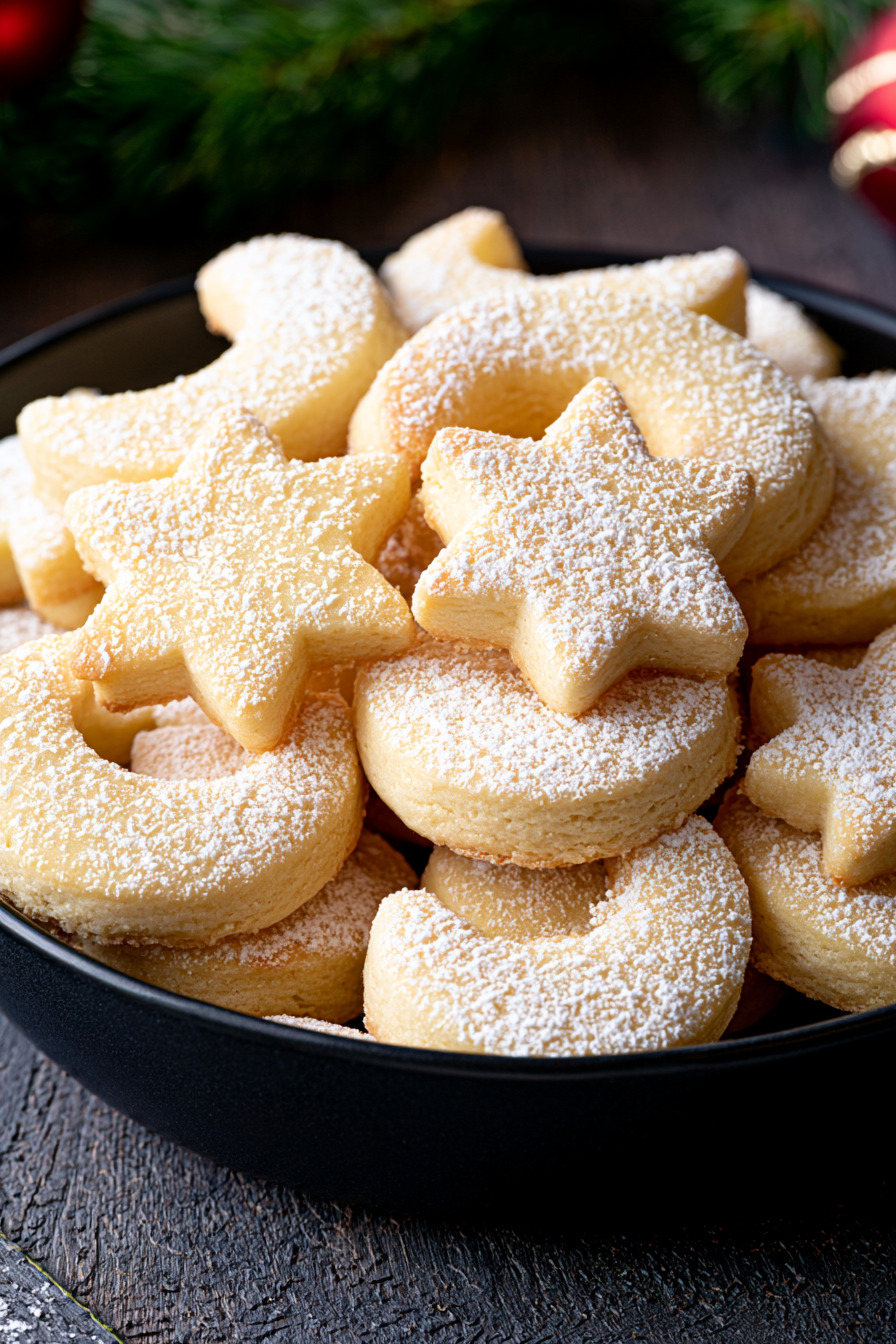
Christmas Cookies with Heavy Cream are tender, buttery holiday cutouts made with a simple cream-enriched dough. They roll beautifully after chilling, bake lightly golden, and finish with a generous snowy coating of confectioners’ sugar.

These cookies are a lovely choice when you want something simple for a Christmas cookie tray without preparing frosting, decorating icing, or a long list of ingredients. Heavy cream adds moisture to the butter-rich dough, while the egg yolk helps everything come together with a delicate, tender texture.
The finished cookies are thin, lightly crisp around the edges, and softer through the center when you avoid overbaking them. Their simple buttery flavor also makes the confectioners’ sugar coating stand out without making the cookies feel overly complicated.
Because you can use almost any small holiday cookie cutter, this dough works especially well for stars, trees, snowflakes, bells, and other festive shapes. Prepare the dough ahead of time, let it chill thoroughly, and you will have a manageable dough that is much easier to roll and cut cleanly.
Christmas Cookies with Heavy Cream Ingredients
You only need five basic ingredients for these Christmas cookies, so the way you handle the dough matters just as much as what goes into it.
All-purpose flour: Provides the structure for the cookies and creates a dough firm enough to roll and cut. Use additional flour sparingly when rolling so the cookies stay tender.
Unsalted butter: Forms the rich base of the dough and contributes to its delicate texture. The butter should be softened enough to blend into the flour but should not be melted.
Heavy cream: Adds moisture and richness while helping the dough develop a smooth consistency without requiring a whole egg.
Egg yolk: Helps bind the flour, butter, and cream while contributing richness to the finished cookies.
Confectioners’ sugar: Coats the warm baked cookies and gives them their characteristic snowy Christmas finish.
Helpful Tips
- Chill the dough for the full 1 1/2 hours. Firm butter makes the dough easier to roll, reduces sticking, and helps the cutouts maintain their shape.
- Roll the dough evenly to about 1/8 inch thick so cookies on the same baking sheet finish at roughly the same time.
- Watch the cookies closely toward the end of baking. They should become only lightly golden rather than deeply browned.

Cooking Steps
STEP 1: Add the flour, softened butter, heavy cream, and egg yolk to a large mixing bowl. Begin working the cream and yolk into the flour with a fork, then use your fingertips to distribute the softened butter until the mixture looks crumbly.
STEP 2: Transfer the crumbly mixture to a clean work surface. Bring it together with your hands and knead only briefly until a soft, smooth dough forms. If it clings heavily to your hands or the counter, use a very light dusting of flour rather than adding a large amount.
STEP 3: Form the dough into a compact cylinder or thick disk. Wrap it securely and refrigerate for 1 1/2 hours. This resting time firms the butter and makes the dough much easier to handle when you begin rolling.
STEP 4: Near the end of the chilling time, preheat your oven to 360°F (182°C) and line a baking sheet with parchment paper. Place the chilled dough on a lightly floured work surface and roll it evenly to approximately 1/8 inch thick.
STEP 5: Cut the dough with your preferred Christmas cookie cutters. Small and medium cutters are particularly convenient because the delicate shapes are easier to transfer. Use a thin spatula or pastry scraper if necessary to lift them without stretching the dough.
STEP 6: Arrange the cut cookies on the prepared baking sheet, leaving a little room between them. Bake for approximately 10 to 12 minutes. Start checking at the lower end of the range and remove the cookies once their surfaces and edges show a light golden color.
STEP 7: Move the baked cookies carefully to a wire rack and let them cool for about 5 minutes. While they are still warm, coat them generously with confectioners’ sugar. Allow them to finish cooling before arranging or storing them.
Why does the dough need to chill?
Chilling firms the butter after the dough has been handled. A colder dough is less sticky, rolls more cleanly, and usually requires less added flour. It also helps delicate cut shapes stay neater as you transfer them to the baking sheet.
Skipping or significantly shortening the chilling period can leave you with a much softer dough that is harder to roll thinly.
Can I prepare the cookie dough ahead of time?
Yes. The dough is well suited to advance preparation because it already requires refrigeration before rolling. Wrap it tightly so the surface does not dry out, then refrigerate it until you are ready to continue.
If the dough becomes very firm during a longer chill, leave it at room temperature briefly before rolling. You want it firm but still workable.
How do I keep the cookies tender?
The most important step is avoiding overbaking. Remove the cookies once they become lightly golden rather than waiting for dark brown edges.
It also helps to use only the flour you need when rolling. Continually adding extra flour to prevent sticking can gradually make the dough firmer and the baked cookies less delicate.
Should confectioners’ sugar go on warm or cold cookies?
Coat these cookies while they are still slightly warm, about five minutes after they leave the oven. The gentle warmth helps the confectioners’ sugar cling to the surface and creates the snowy coating that gives the cookies their festive appearance.
Do not try to handle them immediately from the oven, however. Very hot, thin cookies can be fragile.
Can I use different Christmas cookie cutters?
Absolutely. Stars, trees, hearts, bells, circles, and snowflake-style cutters can all work. Smaller cutters are especially useful for this thin dough because the shapes tend to transfer more easily and bake consistently.
Try to group similarly sized cookies on the same baking sheet. Tiny cookies can finish faster than large cutouts.
Serving Ideas for Christmas Cookies with Heavy Cream
Serve these powdered sugar cookies as part of a holiday cookie platter alongside other contrasting cookies, such as chocolate cookies or warmly spiced Christmas treats. Their pale, snowy finish makes them especially attractive on mixed trays.
They are also a natural pairing with hot chocolate, coffee, tea, or another warm seasonal drink. The simple buttery flavor works particularly well when you want a cookie that will not overpower your beverage.
For holiday gatherings, arrange several different cutout shapes together on a serving plate. Since the confectioners’ sugar provides the decoration, you can create a festive presentation without needing additional frosting.
Keeping Leftovers Fresh
Allow the cookies to cool completely before storing them. Placing warm cookies into a closed container can trap moisture and soften their delicate texture.
Keep the cookies in a tightly covered container at room temperature for several days. If your kitchen is particularly warm, choose a cool, dry cupboard away from the oven or direct sunlight. You can add another light dusting of confectioners’ sugar before serving if the original coating has absorbed into the cookies.
For longer storage, freeze the fully cooled cookies in a freezer-safe container with parchment between layers. They can generally be kept frozen for about 1 to 2 months for the best texture. Thaw them at room temperature while still protected from excess moisture, then refresh the confectioners’ sugar coating after thawing.
These cookies do not require reheating before serving. In fact, heating them can melt or absorb the powdered sugar coating. Let refrigerated or frozen cookies return naturally to room temperature instead.
With their short ingredient list, manageable chilled dough, and simple powdered sugar finish, these Christmas cookies are an especially useful option for busy holiday baking. The heavy cream helps create a rich, tender dough, while careful rolling and light baking keep the finished cutouts delicate enough for a classic Christmas cookie platter.
Christmas Cookies with Heavy Cream
Ingredients
- 3 1/2 tablespoons heavy cream for added moisture and improved texture
- 1 large egg yolk
- 1 1/2 cups all-purpose flour
- 1/2 cup confectioners’ sugar for coating
- 1 1/4 sticks unsalted butter softened to room temperature and cut into pieces
Instructions
- Place the all-purpose flour, softened butter pieces, heavy cream, and egg yolk in a large mixing bowl.
- Using a fork, begin incorporating the egg yolk and cream into the flour mixture.
- Continue combining the ingredients with your fingertips until the mixture develops a crumbly consistency.
- Turn the mixture onto a clean work surface and knead it briefly, just until it comes together as a soft, smooth dough. If it feels excessively sticky, lightly dust the dough with a small amount of flour as you knead.
- Stop kneading as soon as the dough becomes cohesive. Form it into a cylinder, then cover it securely with plastic wrap.
- Refrigerate the wrapped dough for 1 1/2 hours. Chilling allows the butter within the dough to become firm again, helping prevent sticking when the dough is later rolled and reducing the need for additional flour.
- Once the chilled dough is semi-firm, place it on a work surface and roll it to approximately 1/8 inch (0.3 mm) thick.
- Cut the dough into assorted shapes with cookie cutters. Smaller cutters are preferable when possible, as they can promote more consistent results.
- Arrange the shaped cookies on a parchment-lined baking sheet. A thin pastry scraper may be used to lift and transfer the delicate cutouts while preserving their shape.
- Preheat the oven to 360°F (182°C).
- Bake the cookies for approximately 10–12 minutes, watching them closely and removing them once they develop a light golden color.
- Avoid baking them for too long, since excessive baking can produce cookies with an overly firm texture.
- Transfer the freshly baked cookies to a wire cooling rack and allow them to rest for approximately 5 minutes.
- While they remain warm, generously coat each cookie with the confectioners’ sugar, creating a sweet coating and a classic snowy holiday finish.